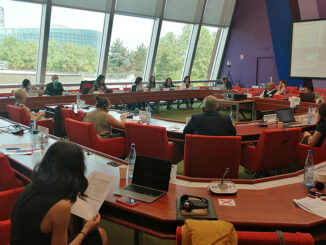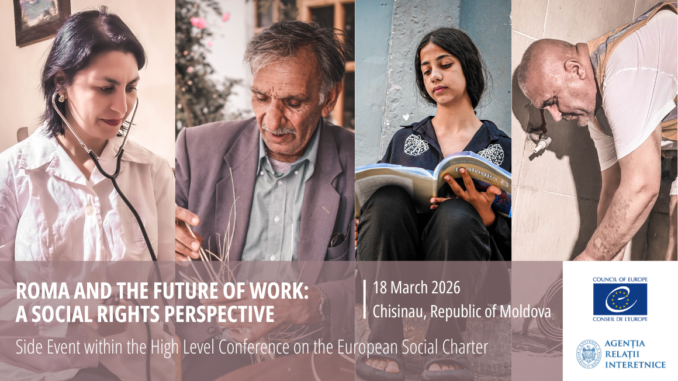
The Roma and Travellers Division/Anti-discrimination Department is organising a side event within the framework of the High-Level Conference on the European Social Charter, in partnership with the Agency of Interethnic Relations, Ministry of Education and Research of the Republic of Moldova. Building on the 2023 Reykjavík Declaration and the 2024 Vilnius Declaration, the 2026 High-Level Conference on the European Social Charter will focus on strengthening the protection and implementation of social rights across Europe. The Conference aims to promote wider ratification and acceptance of the Charter, reinforce political commitment and partnerships, and highlight the Charter’s role as a foundation of the European human rights system.
Venue : Mimi Hotel (Jolly Alon): Maria Cebotari str. 37, room Diva
Registration here
Technological change, including digitalisation, automation, and artificial intelligence (AI), is rapidly transforming labour markets, with major implications for social rights such as the right to decent work, equality, and social protection. While these developments offer new opportunities, they risk deepening existing inequalities if policies and initiatives are not inclusive and accessible.
Roma communities continue to face multiple barriers to employment, including geographical isolation, structural obstacles such as informal work and discrimination, skills and education gaps, digital and AI-related challenges, and limited access to social protection. Without targeted attention, these barriers may prevent Roma from participating fully in the evolving world of work. This side event will explore how labour rights frameworks, legislation, and employment policies and initiatives can be adapted to address these challenges. It will highlight persistent gaps, promising practices, and the role of governments, social partners, and civil society in designing inclusive, rights-based measures that enable Roma to access quality employment.
The event will be a moderated panel with policymakers, Roma civil society, and partners, discussing barriers and solutions to inform rights-based policies and inclusion.
15:30 – 15:45 – High-level opening and welcoming remarks
H.E. Maia Sandu, President of the Republic of Moldova
Alain Berset, Secretary General of the Council of Europe
15:45 – 17:30 – Moderator: Aurora Ailincai, Head of Anti-discrimination Department, Council of Europe
Panellists:
- Improving the access to education for all- Dan Perciun, Minister of Education and Research, Republic of Moldova
- Inclusive labour practices in Romania – Ciprian‑Nicolae Văcaru, State Secretary, Ministry of Labor, Family, Youth and Social Solidarity, Romania
- Bridging education and employment: mentorship pathways into public service- Ina Majko, Deputy Minister of Health and Social Protection, Albania
- Enabling access to the labour market through entrepreneurship and access to finance- Petrica Dulgheru, Executive Director, REDI Fund
- Successful programmes for inclusive education of Roma- Claudia Craiu, Public Affairs Director, Roma Education Fund
- Social rights perspective – Kristina Koldinská, Member of the European Committee of Social Rights (ECSR), Professor, Faculty of Law, Charles University of Prague
Contributing Speakers:
- Liliana Grosu, Member of Parliament, Member of the Parliamentary Committee on Social Protection, Health and Family, Republic of Moldova
- Felicia Bechtoldt, State Secretary,Ministry of Labour and Social Protection, Republic of Moldova
- Veaceslav Reabcinschii, General director, Agency for Interethnic Relations, Republic of Moldova
Objectives of the event
- Examine how policies and initiatives in education and employment can advance the social rights of Roma and vulnerable communities, support their inclusive transitions to the labour market, and ensure they have equal access to decent work.
- Identify the main barriers Roma face in accessing employment, including discrimination, low education and skills, limited local opportunities, and lack of guidance or mentorship.
- Share experiences and good practices that strengthen education-to-employment pathways, promote equality and inclusion, and inform international discussions on just and inclusive labour markets.
redaktionen@dikko.nu
Att vara en oberoende tidning, som inte har några bidrag, kostar pengar därför använder vi oss av crowdfunding. Det innebär att människor med små eller stora summor hjälper till att finansiera vår verksamhet. Magasin DIKKOs insamlingen sker via swish: 123 242 83 40 eller bg: 5534-0046
Vill du annonsera eller sponsra, synas eller höras i våra media?
Kontakta oss på redaktionen@dikko.nu
eller ring 0768 44 51 61
IBAN: SE19 9500 0099 6042 1813 4395
BIC: NDEASESS