What remains of Roma women in a world that appropriates their heritage while ignoring their efforts?
| Text: Written by F. M., Roma feminist and activist and edited by Maria Dumitru, social scientist, and co-founder of Chanipen, a pioneering Romani-led organisation dedicated to advancing research, memory, and justice within Romani communities. DIKKO finns på Facebook, LinkedIn, TikTok och Instagram |
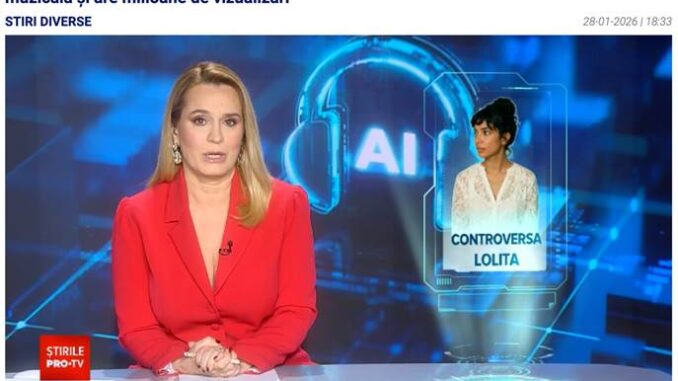
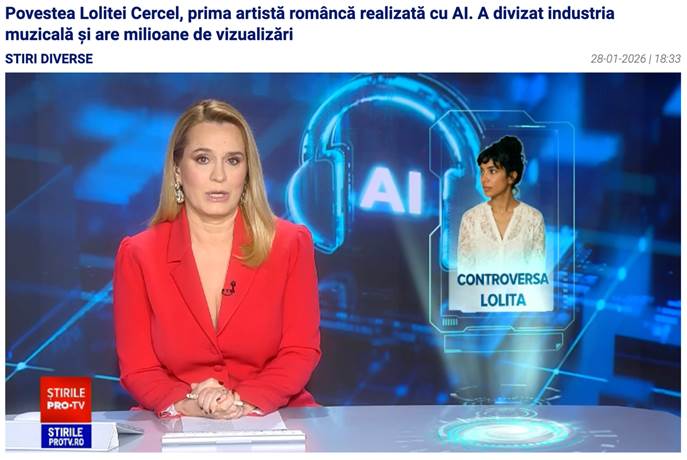
The other day, we were listening to some recent Romanian music and encountered the phenomenon of Lolita Cercel—an AI female artist who reminds Romanians of old lautari, manele, and pop music, blending these styles into something that listeners find appealing or at least familiar. However, there is a problem: Lolita Cercel is not a Roma woman, despite evoking feelings of nostalgia for good old times, and being socially applauded.
Lolita Cercel did not appear out of nowhere. She is not a technological accident or a quirky cultural moment and neither a neutral experiment. She is the logical outcome of a society that has spent centuries deciding which Roma voices are allowed to be heard, and which are better replaced.
Lolita is not an artist as many people call her. She is a construction. And like all constructions, she tells us far more about the people who built her than about the people she claims to represent. She appears for the public as a Roma woman without the burden of Roma history of pains. She sings of love, betrayal, longing, magic, the familiar emotional repertoire that dominant culture has always been comfortable consuming from us, while remaining carefully emptied of politics, memory, and resistance. She is expressive but never demanding. Visible, but never accountable, and present everywhere real Roma women have been systematically excluded.
She will never mention the 500 years of Roma enslavement, nor she will speak of the tens of thousands of deported and killed Romani people during the Roma Holocaust. Events that still are denied and erased from the Romanian and European collective histories and thinking.[1] She will never talk about forced sterilization, about hospital corridors where Roma women are left to bleed, about schools where Roma children are segregated, or about the limited opportunities that Romani women and girls face in real life. She will not speak of these things because she cannot: She is not real.
For centuries, Roma women have existed in the gadje imagination as contradiction.
For centuries, Roma women have existed in the gadje imagination as contradiction: navigating both desire and disgust while being despised, exoticized and erased. Hypervisible in stereotype and invisible in reality. What makes this fantasy so effective is the illusion that race is stable, that it is something one can step into safely once society decides it is harmless. But race has never worked that way. Race is not a biological truth but a political story and construction, rewritten whenever power needs a new boundary. The safety Lolita inhabits is conditional, being made possible precisely because she can never outgrow the limits placed on her.
Her physical appearance draws selectively from what gadje audiences find appealing: dark curly hair, olive skin, full lips, sensuality, mysticism, emotional pain. But these elements are detached from their social context. Roma womanhood is reduced to a stereotype and where a historical stigmatized culture, becomes a trendy costume. This is whitewashing, not in the sense of erasing Roma elements, but in the sense of filtering them through white comfort. A version that the dominant culture can consume, take the bits it finds exciting, exotic, erotic and leaves the rest, so that we don’t threaten the consumer’s comfort but also the bias of the creator behind Lolita.
What makes this more than symbolic violence is where Lolita Cercel is allowed to exist. She is played on radio stations that have never given consistent space to Roma women singing manele or muzică lăutărească. She appears on mainstream TV platforms that have historically treated Roma music as vulgar, dangerous, or unfit for “respectable” audiences. She is reportedly signed and distributed through professional industry channels that real Roma women artists and singers have spent decades knocking on and being shut down. Artists like Laura Vass, Narcisa, or Prințesa de Aur were never granted this legitimacy. Their music was tolerated only in segregated cultural spaces, stigmatized as “too Roma,” “too ghetto,” “too G*psy.”
They have given her a name that cannot be read innocently because it carries the weight of infantilization, sexualization, the ultimate fantasy of the male gaze, the child-woman who exists only to be desired. They have also given her a surname that echoes one of the most famous manele singer in Romania, Cercel, a marker of the culture they are pillaging. They have written her songs inspired by Romani culture, described with the slur țig*nești. Her music is about Roma people, without Roma people. Written by a non-Roma man, for a non-Roma audience, featuring the parts of us that are easy to love. From a feminist standpoint, this is not only cultural appropriation but also gendered extraction. Roma women’s emotional labor, pain, and intimacy are mined and repackaged while our political, anti-racist and feminist voices remain unwelcome. We are allowed to be desired, consumed, but to be not listened to. Because our voices despite strong and loud as it is, it is mute in face of the oppressors.
The anonymity surrounding Lolita Cercel’s creator, Tom, is framed as an artistic choice. In reality, anonymity is protection. It’s the structural privilege of taking without being seen taking. It’s the power to extract without ever having to look the extracted in the eye. A non-Roma man can create a Roma woman, who can speak through her, profit from her, and never have to face the communities he is drawing from. Never has to face the centuries of dehumanization and never has to carry the pain of being a stigmatized body.
Anonymity also allows race to be treated as something flexible, almost optional. An AI Roma woman can be Roma only when it is profitable and step out of Roma-ness the moment it becomes inconvenient. Real Roma women do not have that choice. The distance between those two realities is not creative freedom, it is power. Every moment that Lolita Cercel spends on the radio is a moment that a real Roma woman artist who has worked and dedicated her life to art is not. They are not just stealing our culture. They are stealing our future. They are building a world in which there is no place for Romani women. They are also preventing Romani girls and teens to dream and imagine a real Romani woman being appreciated in the public and being valued for its talent and contributions. We don’t need AI. We want real artists, like Zita Moldovan, Printesa de Aur, Mihaela Dragan, Oana Rusu and many others to occupy these spaces.
The deepest violence here is not that Lolita Cercel exists. It is that she exists instead of Romani women. Lolita Cercel has no pachiv. She has no weight. She has no ancestors. She has no memory of slavery and Holocaust, no grief of sterilization, no rage of eviction, no joy of resistance. She is light in every sense, weightless, effortless, free of the burden that makes us who we are. And that is why they love her. That is why they will always love her more than they could ever respect and love Romani women. Because to love us would mean carrying some of that weight. To love us would mean acknowledging what was done, what must be repaired, what is still being done. To love us would mean seeing us as humans, as citizens, with rights, with demands. There are no ways how to end this, but one thing is sure: Lolita is still singing. The real women are still invisible. The white man is still anonymous and rich and safe.
Written by F. M., Roma feminist and activist and edited by Maria Dumitru, social scientist, and co-founder of Chanipen, a pioneering Romani-led organisation dedicated to advancing research, memory, and justice within Romani communities.
Optional Annex
There is another layer that cannot be ignored: the regulatory vacuum surrounding generative AI and cultural expression. Not because lawmakers have not attempted to regulate AI, but because the legal protections that exist were not designed to address the extraction and reproduction of cultural identity through algorithmic systems.
Table: Legal protections and gaps in the EU framework
| Legal framework | What it protects | Key limitation for AI and cultural expression |
| Directive (EU) 2019/790 on Copyright in the Digital Single Market (DSM Directive) | Copyright protects identifiable works such as recordings, compositions, and performances. Articles 3–4 introduce text and data mining (TDM) exceptions allowing automated analysis of large datasets. | Copyright does not protect vocal timbre, musical style, or cultural aesthetics. AI models can analyze works for training purposes under TDM exceptions without reproducing the original recordings, meaning stylistic imitation may fall outside infringement thresholds. |
| EU Artificial Intelligence Act (Regulation (EU) 2024/1689) | Introduces transparency obligations for generative AI systems, including disclosure of AI-generated content and documentation about training data for foundation models. | The Act does not require consent from artists or communities whose works are used in training datasets, nor does it establish remuneration mechanisms or cultural protections for artistic style or identity. |
| European Parliament reports on generative AI and copyright (2024–2026) | Policymakers have proposed stronger transparency requirements, licensing frameworks for training data, and remuneration for rightsholders. | These proposals remain policy recommendations rather than binding legal protections, leaving artists without enforceable rights over AI training uses of their work or style. |
Taken together, these frameworks reveal a structural gap. Existing law protects discrete works, identifiable personal data, and certain forms of market transparency, but not cultural style, vocal identity, or collective artistic expression. For communities whose cultural production has historically been extracted without ownership, including Roma artists, this creates a double exclusion: first from institutional recognition, and then from legal remedy.
[1] Margareta Matache (2025). The Permanence of Anti-Roma Racism. (Un)uttered Sentences. Routledge
redaktionen@dikko.nu
Att vara en oberoende tidning, som inte har några bidrag, kostar pengar därför använder vi oss av crowdfunding. Det innebär att människor med små eller stora summor hjälper till att finansiera vår verksamhet. Magasin DIKKOs insamlingen sker via swish: 123 242 83 40 eller bg: 5534-0046
Vill du annonsera eller sponsra, synas eller höras i våra media?
Kontakta oss på redaktionen@dikko.nu
eller ring 0768 44 51 61
IBAN: SE19 9500 0099 6042 1813 4395
BIC: NDEASESS